Women say please to the AI about fifty percent more than men do. We know because we read 26,706 real prompts — 677 women, 697 men, gender on file because they told the researchers themselves.
The manners are worth something, too. In a separate experiment where we graded the answers, saying please bought about one extra working answer in every nine tries.
She says please. He says "in bullet points."
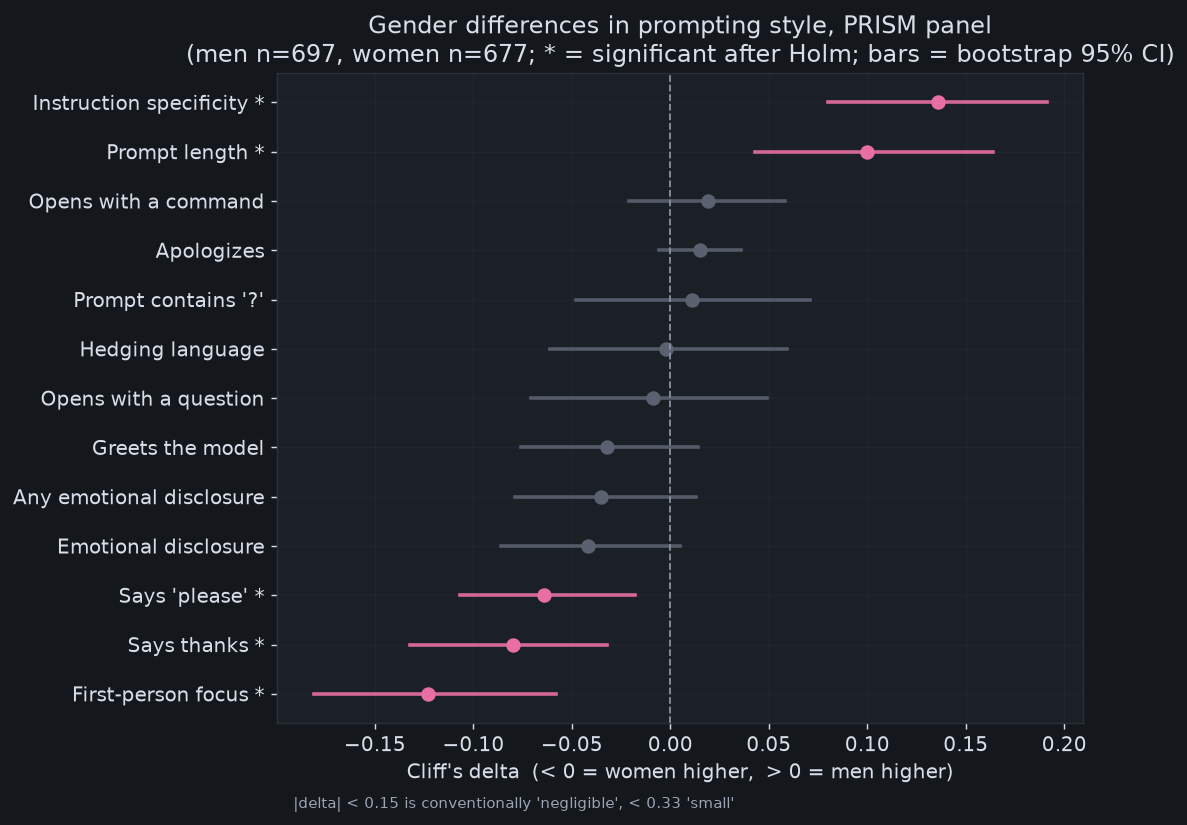
Please shows up in 2.3% of women's prompts and 1.5% of men's, and it holds up every way we sliced the data. Thanks runs the same direction, 4.2% to 3.0%. People say this about themselves, too: in a 17-country YouGov survey, 21% of women called themselves always polite to AI against 17% of men.
Saying please got one extra working answer in every nine tries — 957 of 1,500 coding tasks right against 787 without it. Women do it fifty percent more often than men.
Men's prompts carry more instructions instead. "In bullet points." "Exactly 3." "Step by step." "Format as a table." He adds about 40% more of those — roughly one formatting instruction every five prompts, against one every seven for her — and it is the largest difference in the study. It widens with education: among people with graduate degrees the gap roughly doubles.
Women write more about themselves — who they are, what the situation is, what they need the answer for. About 18% more first-person words per hundred.
So the split isn't polite versus blunt. She hands the model her situation and lets it work out the shape of the answer. He hands it the shape and lets it guess the situation. Both are leaving something on the table: his answers come back generic because the model never learns what the question is for, and hers come back in whatever format the model felt like, because she never said.
The oldest claim about how women write is a zero
Robin Lakoff's Language and Woman's Place put hedging at the center of what she called women's language in 1975: the softening, the qualifying, the maybe and I-think and sort-of. Fifty years later it is still the thing people are most sure of.
Women hedge 0.48 times per hundred words. Men hedge 0.44.
One extra "maybe" every three thousand words. That is the entire gender gap in hedging, across 26,706 prompts — the most confident claim about how women write, and it is dead.
That interval is pinned tight around zero. This isn't a failure to detect something small; there is nothing there.
The mirror image fails too. Men open with a flat command 4.5% of the time, women 4.0%, and that difference is noise. What almost everyone does instead is ask a question — 70% of men's openings, 71% of women's — which is the actual lesson of this section: the most common prompt in the corpus, from anyone, is a question asked the way you'd ask a colleague who knows more than you.
Does the please actually do anything?
The corpus can't answer that, because nobody in it was graded. So we ran it separately: the same coding tasks wrapped in different tones, preregistered, every answer's code executed against tests written beforehand.
Polite prompts got 957 of 1,500 coding tasks right. Neutral prompts got 787. Sixty-four percent against fifty-two — for one word.
That's the stronger of the two models we tested. On the weaker one the manners made no difference at all, which is the useful shape of the finding: politeness pays on a model good enough to notice it, and every model you'd actually reach for is that good.
The gap follows gender, not schooling
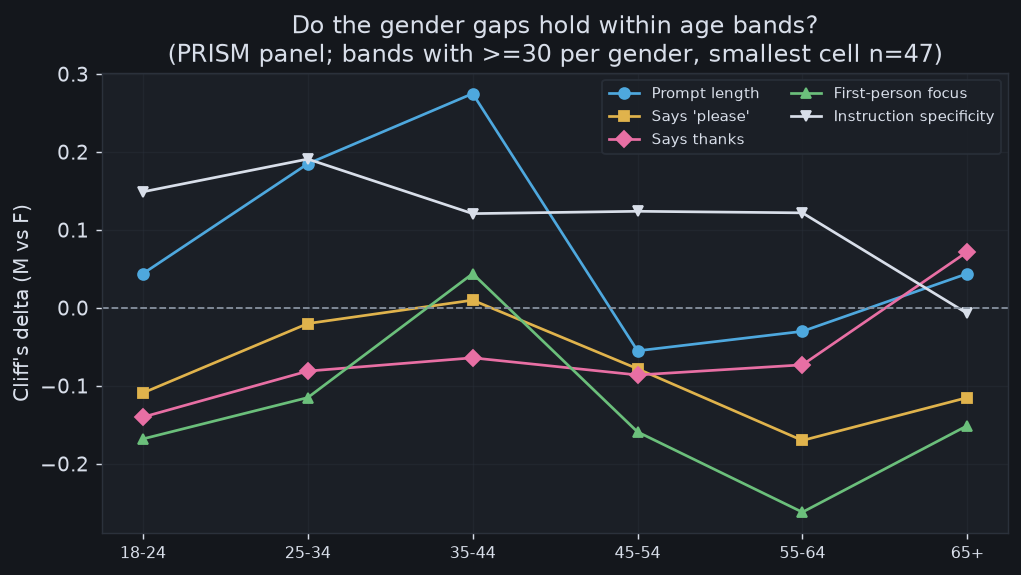
Controlling for age, education and English proficiency barely moves any of it. The habits hold their direction in every age band but one and in at least four of five education bands. Prompt length is the soft member of the set — among 45- to 64-year-olds it reverses.
What to take from the other one
Steal the spec. Add the formatting sentence — "in bullet points," "exactly 3 options," "step by step." One line at the end of what you already wrote.
Steal the story. Add one sentence about who you are and what the answer is for. A spec can't carry it.
Say please. One more working answer in nine.
The two distributions overlap 86 to 93%, which means these are habits and not fingerprints — hand us a single prompt and we couldn't tell you who wrote it. That's the good news, because a habit is something you can pick up in one sentence.
She has the context, he has the spec, and the model wants both.
Reproduce it
Everything — fetch, features, statistics, figures — is in experiments/prism-gender-prompting, MIT licensed. The prompts come from PRISM Alignment (Kirk et al., NeurIPS 2024, CC-BY-4.0), a paid research panel: 1,396 people, 8,011 conversations, and the 26,706 prompts from the 677 women and 697 men compared here. The tone result is a separate preregistered experiment, experiments/tone-v4.
./experiments/prism-gender-prompting/fetch_data.sh
.venv/bin/python experiments/prism-gender-prompting/run.py
.venv/bin/python experiments/prism-gender-prompting/analyze.py
Every statistic traces to results.json, and the word lists are plain text in run.py. If you think our hedging list is wrong, change it and re-run.